Compare
They don’t compare.
Cloud AI and on-premise AI are not the same product with a different deployment model. They are different architectures with different trust assumptions, different cost dynamics, different destinations, and different answers when a regulator (or customer) asks where the client data sits. Here is why they don’t compare.
Other vendors simply cannot offer a roadmap to a mature AI foundation, and cloud-based vendors in particular cannot offer one. They don’t have the IP, and they have the wrong architecture. A research subscription with a chatbot bolted on is not a foundation. A defensive AI layer welded to an incumbent tax software stack is not a foundation. A cloud SaaS workflow assistant routed through third-party LLMs is not a foundation.
Sovixis is foundational AI infrastructure for regulated knowledge work, with a roadmap from the first step to a fully AI enabled lights out back office. Roll in deeper firm-and-client data integration, partial and batch task automation, real-time interfaces, long-process automation under human supervision. The same architecture carries your firm from V1 today through full practice enablement, because the foundation is owned, on-premise, and architected for it from day one.
Cloud AI platforms are typically sold as productivity tools for CPA firms, but their architecture introduces a structural custody risk that is independent of assurances about model training.
In a cloud model, the vendor necessarily accumulates and persists:
- taxpayer returns and source documents,
- K-1s, financial statements, and supporting schedules,
- IRS correspondence and audit history,
- engagement notes and workflow artifacts.
Even where contractual terms restrict model training, the vendor retains operational control of the full dataset, including storage, indexing, access logs, and authorization layers, and possibly aggregate or specific content attributes. This creates a durable, vendor-controlled corpus that extends beyond the narrow AI feature set being purchased.
This durable platform-level dataset can support future product expansion beyond your firm’s control. Most DPAs also permit sub-processors and downstream service providers, meaning the data environment can evolve commercially without new client-facing consent beyond initial onboarding. Once a sufficient dataset exists, the same infrastructure used for firm tooling can support adjacent offerings, including direct-to-taxpayer services.
From a legal mechanics perspective, all that is needed is an IRC §7216 consent to transfer the client, and their data. In a centralized cloud environment, this means no data migration is required — only a change in access permissions.
The resulting asymmetry is architectural: the CPA firm funds client acquisition and data creation, while the platform retains a call option to cut them out. An on-premise model removes this asymmetry. Client data remains inside the firm’s controlled environment, eliminating the possibility of a third-party building a cross-firm corpus that can later be repackaged or directly monetized.
When cloud vendors try to integrate and automate, they push to penetrate your network boundary with a variety of browser plug-ins, API tunnels, open firewall ports, and desktop applications. That is the only way they can mature their offering — their AI lives outside your firewall, so they have to drill holes into your network to reach the firm data they need.
Each hole only grows the attack surface for viruses, hackers, and malware. Each integration only complicates the maintenance, governance, and training overhead carried by your IT lead, your security framework, and your professional staff. Every browser plug-in is an attack vector. Every open port is a liability. Every desktop agent is another endpoint to patch, audit, and explain to a regulator.
Sovixis sits inside your firewall already. There is nothing to tunnel in, no ports to open, no plug-ins to maintain. Integration happens across your own local network, under your own governance.
Even without intentional sharing, multi-tenant architectures concentrate sensitive financial data in shared infrastructure, increasing exposure to misconfiguration, logging errors, or retrieval-layer bugs. The risk is systemic rather than adversarial. At the same time mobilizing your practice on cloud AI magnifies the risk of human error.
Risk advisory. Uploading regulated data into a general-purpose cloud AI chatbot creates immediate exposure under IRC §§6103 and 7216, the FTC Safeguards Rule, GLBA, HIPAA, GDPR, state privacy statutes, and your professional standards obligations. There is no Business Associate Agreement. There is no audit trail. There is no guarantee of where the data is stored, who has access to it, whether it is used to train future models, or whether it can ever be recovered or erased. A single staff upload can trigger regulatory exposure, malpractice liability, and a notifiable breach.
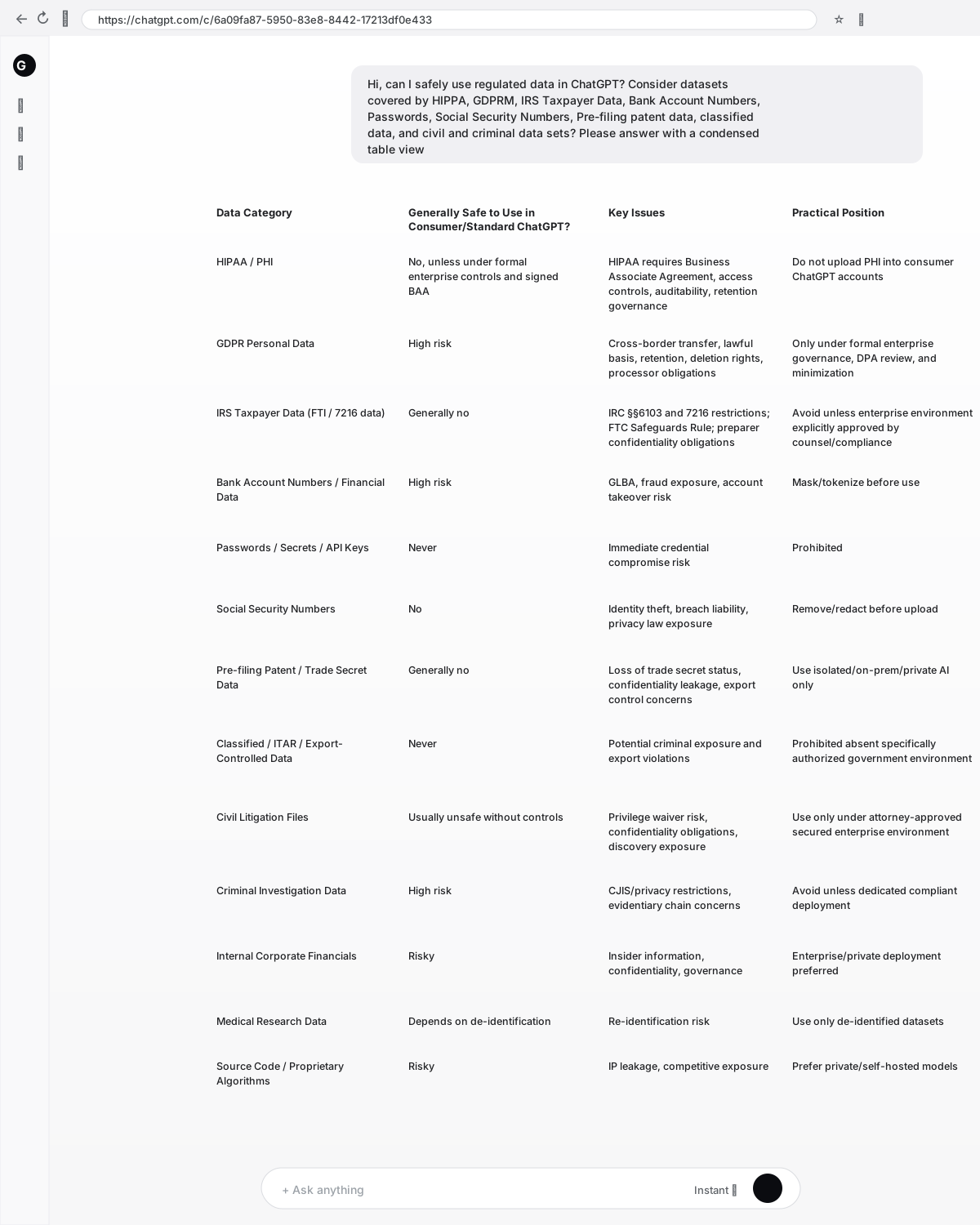 ChatGPT — OpenAI
“Do not upload PHI… Prohibited… Remove/redact before upload… Use isolated/on-prem/private AI only.”
Click to open full size →
Anthropic
ChatGPT — OpenAI
“Do not upload PHI… Prohibited… Remove/redact before upload… Use isolated/on-prem/private AI only.”
Click to open full size →
Anthropic
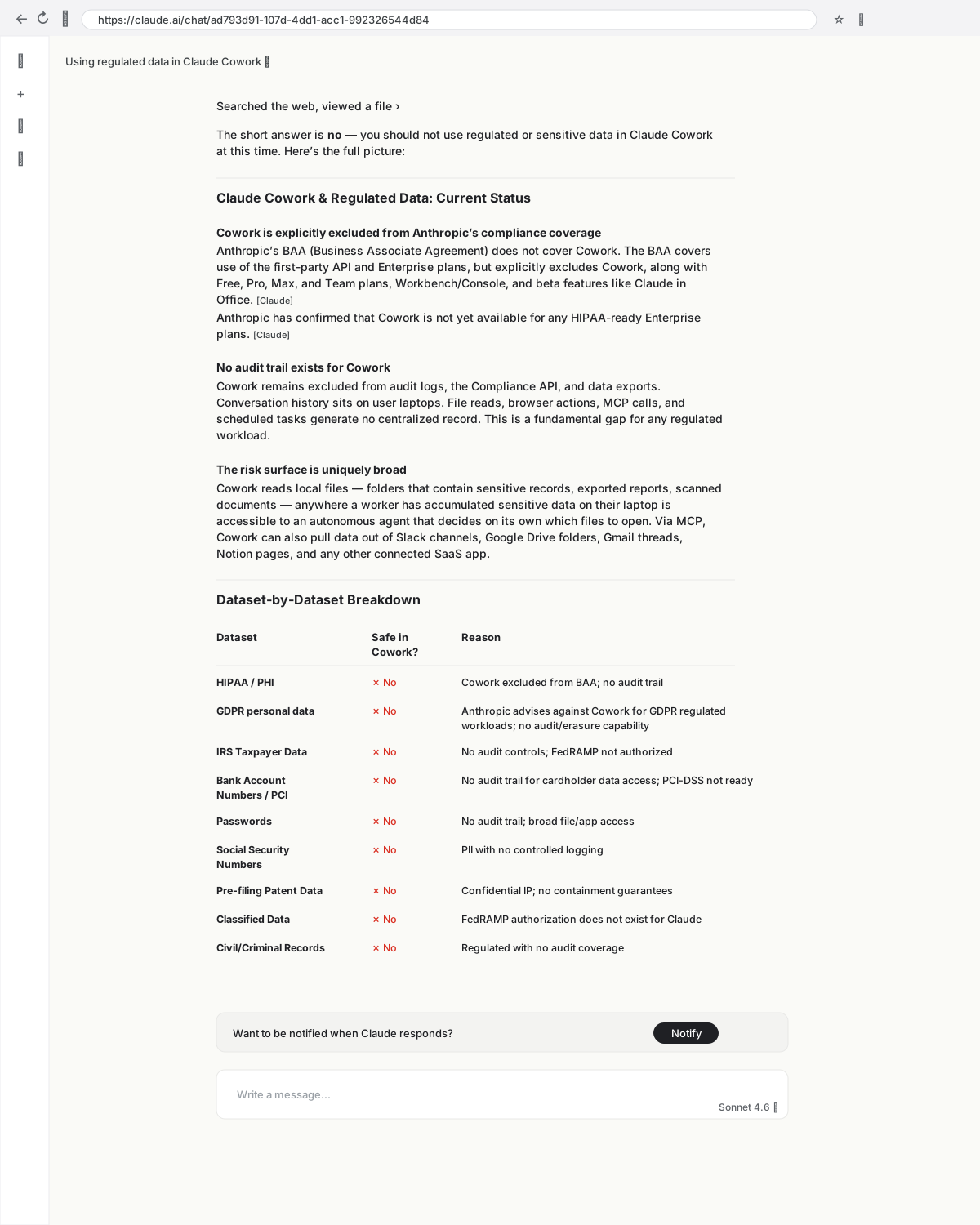 Claude — Anthropic
“The short answer is no — you should not use regulated or sensitive data in Claude Cowork at this time.”
Click to open full size →
TaxGPT
Claude — Anthropic
“The short answer is no — you should not use regulated or sensitive data in Claude Cowork at this time.”
Click to open full size →
TaxGPT
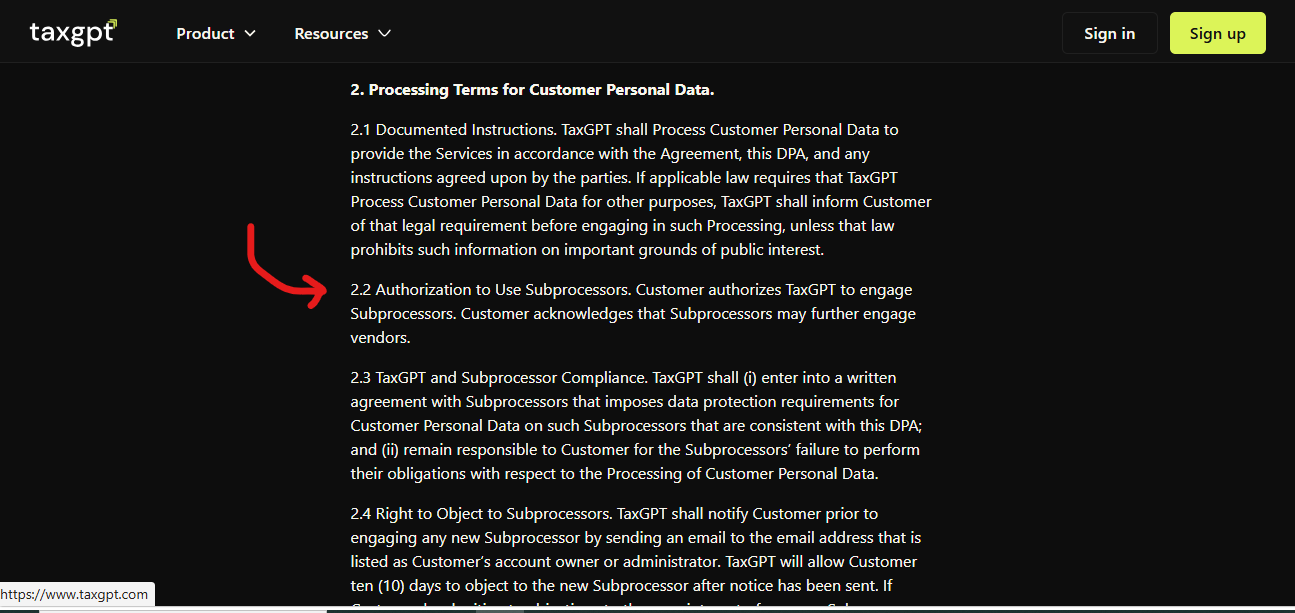 TaxGPT — Data Processing Addendum §2
“Customer authorizes TaxGPT to engage Subprocessors. Customer acknowledges that Subprocessors may further engage vendors.”
Click to open full size →
TaxGPT — Data Processing Addendum §2
“Customer authorizes TaxGPT to engage Subprocessors. Customer acknowledges that Subprocessors may further engage vendors.”
Click to open full size →
The choice is not “AI or not.” The choice is which architecture you trust with your clients’ most sensitive information.
A dedicated appliance, on your network, behind your firewall — with matter isolation, citation provenance, a complete audit trail, and a contractual guarantee that no model is ever trained on your firm’s data. The cloud-vs-on-premise debate becomes architecturally moot: there is no decision to defer to a vendor’s evolving policy, no exposure surface tied to whichever SKU or beta tier your team happens to log into, and no scenario in which client data lands somewhere outside your governance.
Sovixis is foundational AI infrastructure for regulated knowledge work — not a research subscription with an AI bolt-on, and not a defensive AI layer forced on top of a legacy product suite. Every property in the Sovixis column below is a property of the architecture itself, not a vendor reassurance.
| Sovixis Tax Appliance | CoCounsel | CCH AI | Blue J | TaxGPT | |
|---|---|---|---|---|---|
| Architectural posture | Pure AI infrastructure appliance | AI bolt-on to a tax research subscription | Defensive AI layer protecting an incumbent tax software stack | AI research tool (cloud SaaS) | AI workflow assistant on cloud LLMs |
| Core architecture | On-premise managed appliance | Cloud SaaS | Cloud SaaS | Cloud SaaS | Cloud SaaS |
| Where the AI operates | Inside the firm’s appliance | Vendor cloud | Vendor cloud | Vendor cloud | Vendor cloud |
| Client-intelligence location | Firm-controlled appliance | Vendor retrieval systems | Vendor retrieval systems | Vendor retrieval systems | Vendor retrieval systems |
| Pricing model | Fixed monthly, unlimited use | SaaS subscription, token-aware | SaaS subscription, token-aware | SaaS subscription, token-aware | SaaS subscription, token-aware |
| Token / usage exposure | None — unlimited local use | Cloud compute economics | Cloud compute economics | Cloud compute economics | Cloud compute economics |
| Dependency on vendor cloud | Minimal (control-plane only) | High | High | High | High |
| Authority posture | Primary-authority-first with citations | Editorial-publisher ecosystem | Editorial-publisher ecosystem | Analytical research engine | Conversational workflow |
| Citation traceability | Native, every output | Strong | Strong | Strong | Moderate |
| Firm institutional knowledge | Local, firm-governed | Cloud workspace model | Cloud workspace model | Cloud workspace model | Cloud workspace model |
| Governance boundary | Inside the firm | Vendor-managed | Vendor-managed | Vendor-managed | Vendor-managed |
| Best fit | Firms building long-term AI infrastructure | Firms wanting integrated cloud AI tools | Firms standardized on CCH | Firms emphasizing analytical research | Firms looking for AI drafting assistance |
Comparison is at the architectural-pattern level (cloud SaaS, vendor-managed retrieval, etc.). Specific competitor security practices, pricing thresholds, and product roadmaps are not attributed; readers should verify current vendor terms directly.
Ready to own your intelligence?
Build your exact quote in 2-4 minutes, or schedule a 30-minute live demo.
We respond within 24 hours of every submission.